
Get back to what matters most
Your gallbladder is a small organ that stores bile, a digestive juice your liver produces to break down fat in food. After you eat, the gallbladder releases stored bile into your small intestine through narrow tubes called ducts. Gallbladders can become inflamed (called cholecystitis) and ducts can be blocked, often because of small hard masses called gallstones that form, producing symptoms that range from mild discomfort to intense pain.
Understanding your options
To reduce your risk of inflammation of the gallbladder and blockage of the ducts, your doctor may recommend making adjustments to your diet, such as reducing fat intake. Options for an inflamed gallbladder may include fasting, fluids through a vein in your arm, antibiotics, and pain medications.
Your doctor may recommend surgery to remove the gallstones, or even to remove your gallbladder.
Surgeons can perform gallbladder removal surgery, called a cholecystectomy, through open surgery, which requires a large incision in your abdomen, or a minimally invasive approach. Today most gallbladder surgeries are performed through minimally invasive surgery using a laparoscopic approach or robotic-assisted surgery, possibly with da Vinci technology.
Doctors perform minimally invasive laparoscopic or robotic-assisted surgeries through a few small incisions or a single small incision near the belly button. To remove the gallbladder with laparoscopic surgery, doctors use special long-handled tools while viewing magnified images from the laparoscope (camera) on a video screen.
 How da Vinci works?
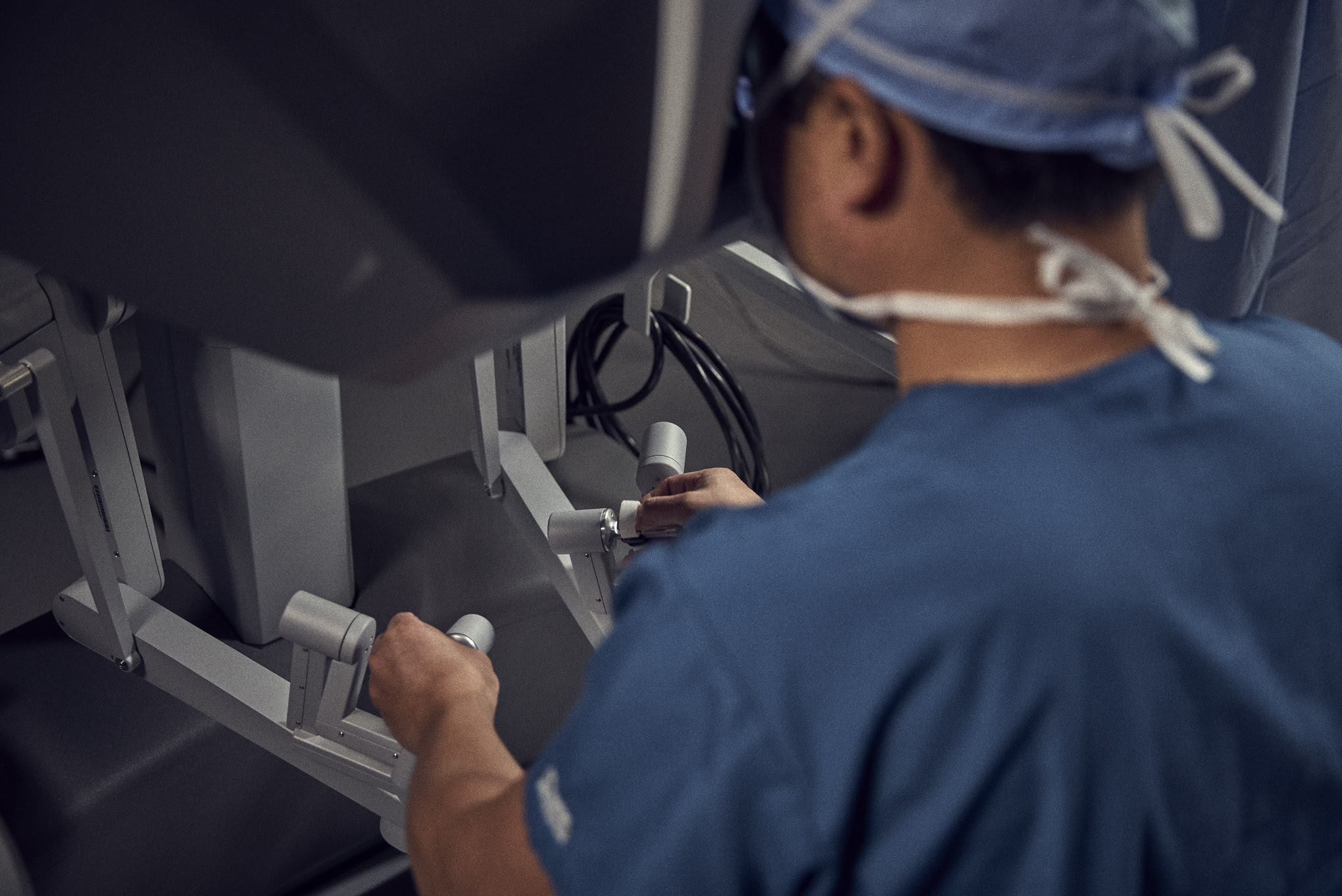
Surgeons using da Vinci technology can remove your gallbladder through either a few small incisions (cuts) or through one small incision in your belly button using Single-Site technology. During surgery, your surgeon sits at a console next to you and operates using tiny instruments.
A camera provides a high-definition, 3D magnified view inside your body. Every hand movement your surgeon makes is translated by the da Vinci system in real time to bend and rotate the instruments with precision.
It’s important to remember that Intuitive does not provide medical advice. After discussing all options with your doctor, only you and your doctor can determine whether surgery with the da Vinci system is appropriate for your situation. You should always ask your surgeon about his or her training, experience, and patient outcomes.
Why surgery with da Vinci?
Robotic-assisted surgery with a da Vinci system gives surgeons access to technology features that include:
A high-definition 3D camera system with high magnification that provides immersive viewing of the gallbladder and surrounding area.
Firefly fluorescence imaging which offers visualization beyond the human eye by activating injected dye to light up and clearly show the gallbladder and surrounding structures, including the ducts.
Da Vinci Single-Site technology, which allows surgeons to make just one incision near the belly button, providing patients with nearly scarless results.
Questions you can ask your doctor
- What medical options are available for my gallbladder pain?
- What happens if I don’t get surgery?
- What are the differences between open, laparoscopic, and robotic-assisted surgery?
- Can you tell me about your training, experience, and patient outcomes with da Vinci?
- How will I feel after surgery?